






WHAT IS IT?
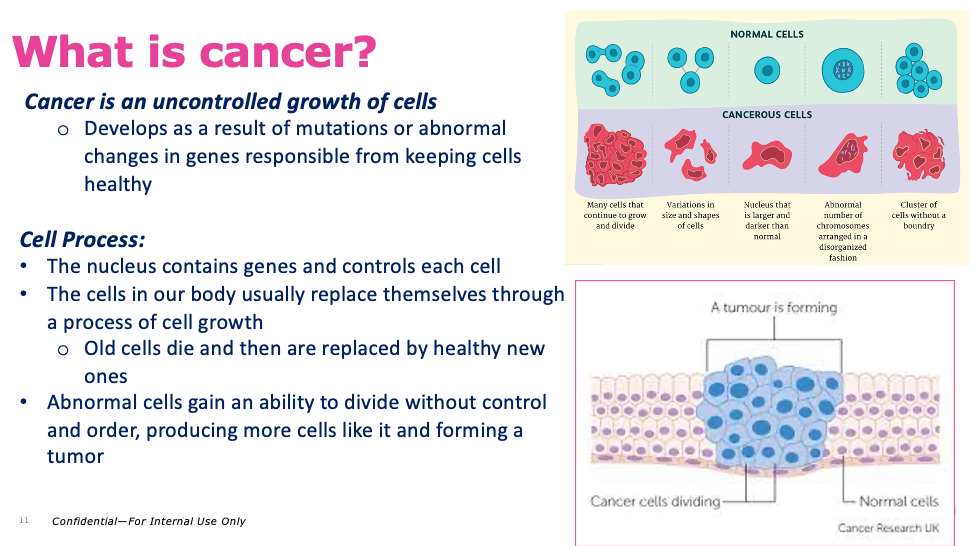
Breast cancer is an uncontrolled growth of breast cells. Cancer develops as a result of mutations or abnormal changes in the genes responsible for keeping cells healthy. The genes are in the cell's nucleus, which controls each cell. The cells in our body normally replace themselves through a process of cell growth, wherein old cells die and are then replaced by healthy new ones. The abnormal cell gains an ability to divide without control and order, producing more cells like is and forming a tumor.
Types of Tumors
A tumor can be benign or malignant. Benign tumors are not cancerous, and cannot spread or invade other parts of the body (not dangerous to health). Malignant tumors are cancerous, and left unchecked can spread beyond the original tumor to other parts of the body.
"Breast Cancer" refers to a malignant tumor that has formed in the breast cells. Breast cancer usually begins in the cells of the lobules. These are the milk-producing glands, or the ducts, the passages that drain milk from the lobules to the nipple. Breast cancer can also begin in the stromal tissues (the fatty and fibrous connective tissues of the breast), which is much less common.
Causes/Prevention
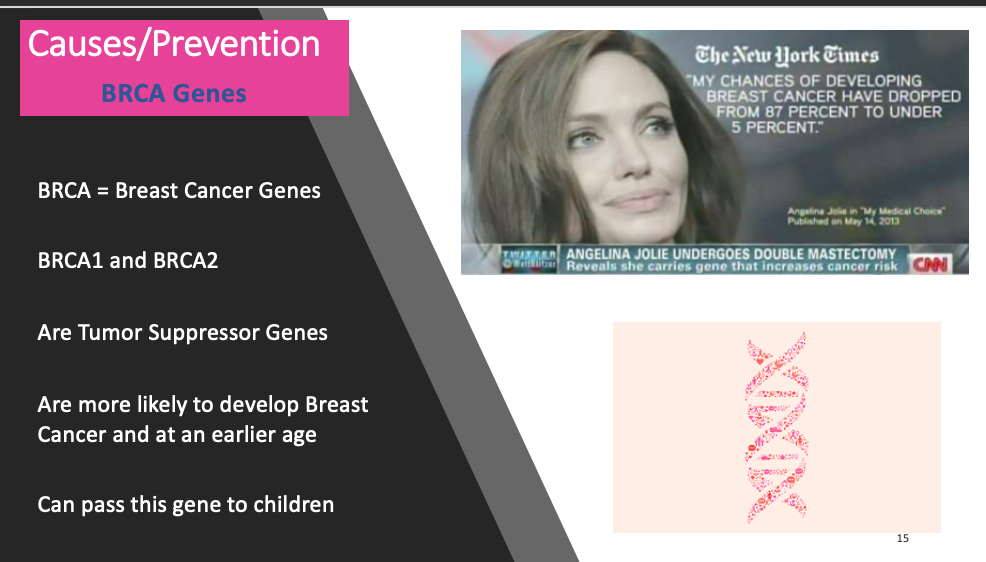
Breast cancer is caused by a genetic abnormality, or a "mistake" in genetic material. However, only 5-10% of cancers are due to an inherited abnormality (from your mom or dad, grandparents). Generally 85-90% of breast cancers are due to genetic abnormalities that happen as a result of the aging process and the "wear and tear" of life in general.
There are steps that every person can take in order to stay as healthy as possible. This includes eating a balanced diet, maintaining a healthy weight, not smoking, limiting alcohol, and exercising regularly. While these thing can definitely help your risk of getting breast cancer, they cannot eliminate the risk.

BREAST CANCER - ORIGIN
"Breast Cancer" is a malignant tumor that has formed in the breast cells
Breast cancer usually begins in the cells of the ducts:
Invasive Ductal Carcinoma= 80%
Lobular Carcinoma= 15%
Other much less common= <5% in the stroll tissues:
Fatty tissue
Connective tissues
BREAST CANCER
IN-SITU
Latin phrase that translates literally to "on site" or "in position"
Ductal Carcinoma in-situ (DCIS)
Accounts for 1 in 5 new Breast Cancers
Stage 0 Breast Cancer
Non-Invasive Breast Cancer
Lobular Carcinoma in-situ (DCIS)
BREAST CANCER STAGES
Breast cancer stage is determined by the cancer's characteristics, which includes many things including size, and whether or not it has hormone receptors. The stage of the cancer is important to figure out the prognosis (outcome), decide on the best treatment options, and factor in the option of clinical trials.
How stage is determined
The TNM system is the most common tool that doctors use to describe the stage of breast cancer. The results of diagnostic tests and scans help them answer these questions:
Tumor (T): how large is the primary tumor in the breast? What are the biomarkers?
Node (N) : Has the tumor spread to the lymph nodes? If so, where, what size, and how many?
Metastasis (M): Has the cancer spread to other parts of the body?
This information is used to determine the stage of cancer for each person. There are 5 stages of breast cancer; stage 0 is non-invasive ductal carcinoma in situ (DCIS), and stages I through IV are used for invasive breast cancer. The stage is crucial in deciding the best treatment option for the patient.

STAGES 0-IV
Stage 0
Describes disease that is only in the ducts of the breast tissue
Has not spread to the surrounding tissue of the breast
Stage IA
The tumor is small, invasive, and has not spread to the lymph nodes
Stage IB
Cancer has spread to the lymph nodes and the cancer in the lymph node is larger than 0.2mm but less than 2mm in size
There is either no evidence of a tumor in the breast or the tumor is 20mm or smaller
Stage IIA
(Any of the following):
There is no evidence of a tumor in the breast, but the cancer has spread to 1 to 3 axillary lymph nodes. It has not spread to distant parts of the body
The tumor is 20 mm or smaller and has spread to 1 to 3 axillary lymph nodes
The tumor is larger than 20 mm but not larger than 50 mm and has not spread to the axillary lymph nodes
Stage IIB
(Any of the following):
The tumor is larger than 20 mm but not larger than 50 mm and has spread to 1 to 3 axillary lymph nodes
The tumor is larger than 50 mm but has not spread to the axillary lymph nodes
Stage IIIA
The cancer of any size has spread to 4 to 9 axillary lymph nodes or to internal mammary lymph nodes
It has not spread to other parts of the body
May also be a tumor larger than 50 mm that has spread to 1 to 3 axillary lymph nodes
Stage IIIB
The tumor has spread to the chest wall or caused swelling or ulceration of the breast, or it is diagnosed as inflammatory breast cancer
May of may not have spread up to 9 axillary of internal mammary lymph nodes, and/or the lymph nodes under the collarbone
It has not spread to other parts of the body
Stage IIIC
A tumor of any size that has spread to 10 or more axillary lymph nodes, the internal mammary lymph nodes, and/or the lymph nodes under the collarbone
It has not spread to other parts of the body
Stage IV (metastatic)
The tumor can be any size and has to spread to other organs such as the bones, lungs, brain, liver, distant lymph nodes, or chest wall
Metastatic cancer found when the cancer is first diagnosed occurs about 6% of the time
This may be called de novo metastatic breast cancer
Most commonly metastatic breast cancer is found after a previous diagnosis of early breast cancer
Recurrent: recurrent cancer is cancer that has come back after treatment and can be described as local, regional, and/or distant. If the cancer does return, there will be another round of tests to learn about the extent of the recurrence.