
ANATOMY OF THE BREAST
What's inside breasts?
In order to understand breast cancer prevention, risks, or diagnosis, it is important to first comprehend the breast composition. This includes the tissues and structures that breasts are made up of. Knowing this will create a better understanding of breast cancer surgery and treatment options.


QUIZLET
We have created flashcards on Quizlet, that includes all of the terminology covered during the first Breast Education Session:
ANATOMY
WHAT IS A BREAST MADE OF?
The female breast contains different types of fatty, fibrous, and glandular tissue.
Glandular tissue includes breast lobes and breast ducts
Fibrous tissue is the type that ligaments and scar tissue are made of
Fatty tissue fills in the spaces between glandular and fibrous tissue; determines your breast size
Non-fatty tissue is the fibroglandular tissue. The supportive connective tissue (ligaments) stretch from the skin to the chest wall to hold the breast tissue in place. The pectoral muscle also plays a role, lying against the chest wall underneath both breasts and giving support. Blood vessels provide oxygen to the breast tissue and carry away waste.
WHAT ARE BREAST LOBES AND BREAST DUCTS?
There are 15 to 20 glands called lobes embedded in the breast's fatty and fibrous tissue. These lobes contain smaller lobules which are called sacs, and they produce milk.
Ducts are the thin tubes that carry milk to the nipple. The nipple is located in the middle of the areola, which is the darker area surrounding the nipple. Breast cancer can form in the ducts and the lobes.
WHAT ARE LYMPH NODES?
Lymph nodes are found all over the body; they are small, bean shaped organs that help fight infections. They produce and filter a colorless fluid called "lymph", which contains white blood cells (lymphocytes).
Lymph vessels filter and carry lymph fluid from the breast to the lymph nodes. There are clusters of lymph nodes near the armpit, known as the axillary lymph nodes.
"DENSE BREASTS"
If breasts are dense, that means that most of the tissue seen on a mammogram is fibrous or glandular breast tissue, as opposed to fatty tissue. These tissues are thick and dense, and appear as white on the mammogram. Sometimes, it is harder for radiologists to identify diseases in women with dense breasts because cancer cells also appear white on the image. Thus, some women with dense breast may be asked to undergo additional imaging tests to detect cancers that otherwise may have gone unnoticed on a mammogram.


DR. ROBERT REHNKE - SCIENTIFIC STUDY
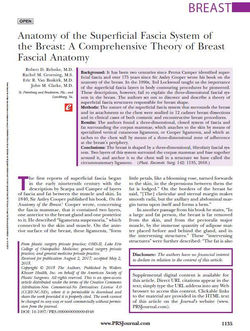
Anatomy of the Superficial Fascia System of the Breast: A Comprehensive Theory of Breast Fascial Anatomy
Dr. Robert Rehnke, breast surgery expert, led a study which aimed to investigate the theory of the superficial fascia structure. This structure was said to be responsible for breast shape, first reported in the early nineteenth century. Dr. Rehnke and his team delved into this topic on an intensified level, studying 12 cadaver breast dissections, as well as in clinical and breast reconstructive procedures.
There is much controversy over the superficial fascia of the breast, which emphasizes the importance of this study. The basis of this disagreement is whether or not the superficial fascia and inframammary fold should be considered a ligament or not. There is extensive debate in the literature, over the existence of one of two layers of superficial fascia in the breast region.
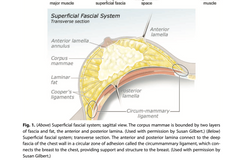
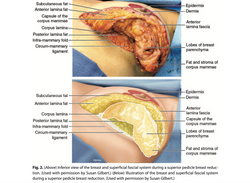
The study results concluded that the breast is shaped by a three-dimensional, fibrofatty fascial system. Two layers of this system surround the Corpus Mammae and fuse together around it, and anchor it to the chest wall in a structure called the circummammary ligament. Thus, the superficial fascia that surrounds the corpus mammae, is in fact a system in the breast and should be deemed a notable ligament. Findings support the fact that aging and surgery can cause stretching and relaxing of the superficial fascia system, which can ultimately lead to breast ptosis (drooping breasts). Ultimately, cosmetic and reconstructive breast professionals should acknowledge and recognize this system and the current research that has been performed.
Breast ptosis: drooping breasts
Inframmamary Fold (IMF): the natural lower boundary of the breast; the place where the breast and the chest meet
 |  |  |
|---|---|---|
 |  |  |
 |  |
Methods
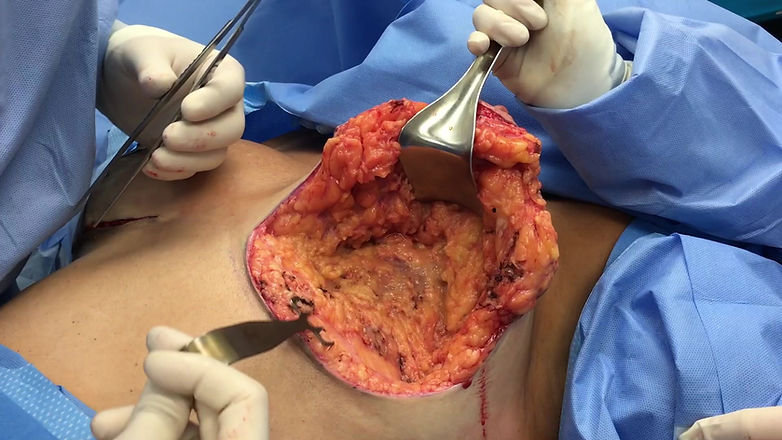
This video from Dr. Rehnke's study demonstrates superior pedicle breast reduction. This illustrates the anterior and posterior lamella of the superficial fascia system of the breast.
ADDITIONAL INFORMATION
Further analyzing breast composition

LOBULES AND DUCTS
Each breast has a number of lobules that branch out from the nipple, as discussed earlier. Each lobule holds tiny sacs, called alveoli. The lobules are linked by a network of ducts. The ducts cary milk from the alveoli toward the dark area of skin in the center of the breast

FATS, LIGAMENTS, AND CONNECTIVE TISSUE
Spaces around the lobules and ducts are filled with fat, ligaments, and connective tissue, The size of the breasts is largely determined by the amount of fat in them. Most women's breast tissue changes as they age, with more fat relative to the amount of dense tissue.

MUSCLES
The breast does not have any muscle tissue, but, muscles lie underneath the breasts, separating them from the ribs.

ARTERIES AND CAPILLARIES
Oxygen and nutrients travel to breast tissue through blood in the arteries and capillaries-- thin, fragile blood vessels.

LYMPH NODES AND LYMPH DUCTS
The lymphatic system is a network of lymph nodes and lymph ducts that helps fight infection. Lymph nodes are found under the armpit, above the collarbone, behind the breastbone and in other parts of the body. They trap harmful substances that might be in the lymphatic system and safely drain them from the body.